
Volume 1 Issue 2 
Gandharvam, A Refereed Journal of Sachin Debbarman Memorial Govt. Music College
PANDIT VISHNU GOVIND JOG :- HIS INNOVATIONS AND APPLICATIONS
-Anirban Biswas
Abstract :-
Late Pt. Vishnu Govind Jog needs no introduction. The maestro was a man of many parts . He is the pioneer of introducing Western Violin into Hindustani Classical music as a solo instrument. Eminent Tabla player Pt. Samar Saha in his interview has rightly pointed out that “Pt.V.G.Jog and the instrument Violin complements each other.”1 He had the opportunity to receive training from many stalwarts like S.C Athavale, Ganpat Rao,Vijnashwar Shastri,S.N Ratanjhankar, Ut.Allauddin Khan.Though he had learnt from many gurus, he was able to establish himself with a unique style of Violin playing. His unique style of Violin has many facets. Pt.Jogji playing style and techniques need a thorough research. His playing style is a blending of Gayaki and Gatkari. PanditJi’s use of Meend,Gamak,use of Sapat,use of Bow, etc are his unique style and his distinctive style made him the immortal Pt.V.G.Jog. Pt.V.G.Jog introduced the playing of bols like Dara-Diri,Diri-Dara, Dirda etc in his violin following the playing style of Sitar and Sarod. He had the capacity to enthrall the audience by playing some light compositions and Folk tunes . One of the main characteristics of Pt.V.G.Jog was that, he could know the taste of the audience and accordingly he used to choose his compositions.
Keyword:- Pt.V.G.Jog, Violin, Raag, Taal, Scale, etc
Introduction :-
“We respect those personalities who marched towards the goal, bearing all the sorrows and sufferings which obstructed them to do so. Pt. Vishnu Govind Jog is such personality and an institution in the field of music and culture.”2 “Pt.Vishnu Govind Jog, also known as Pt.V.G.Jog was born on 22th Feb 1922 in Wai village of Satara district, Maharastra. Initially he received musical training from S.C Athavale ,Ganpat Rao and Mirashi Bua He also learned Violin from Vijnashwar Shastri and also had taken lessons from S.N RatanJhankar. He later became Baba Allauddin Khan’s disciple.”3 He was appointed as a professor of music in Violin at Morris college,Lucknow. He also worked for a long time in Sangeet Research Academy(SRA),Kolkata. His jugalbandi with Shehnai maestro Bismillah was unparalal. He was a performer with the unique distinctions of having occupied the top positions of the classical musicians hierarchy with three consecutive generations of performers. He had a divine appearance filled with smile always and had a very attractive personality .He received Padmabhushan award in 1982 and Sangeet Natak Akademy Award . He passed away on 31-01-2004. He had performed no. of jugalbandis with many artists like Hariprasad Chaurasia,Amjad Ali Khan,Girija Devi, Hirabhai Barodkar, L.Subramaniam,N.Rajam and many more.
His Musical Journey :-
Pt.Jog, the Violin wizard of Hindustani music. In a very little age Pt.Jog lost his father, his brother Sri Shankar Rao Athavle inspired and took care of him. “At early age Pt.Jog started Harmonium training from Ganpat Rao Purohit in Guru-Shishya traditionand was trained in Vocal music .In India Violin was used for the first time in Karnatik music. BaluSwami Dixiter was the first musician to play Indian music in Violin. This instrument was not popular in North India Classical music rather it was popular as a accompanying instrument in Karnatik music. Pt.Jog’s brother had a dream that ,this instrument would be popular one day in future, so his brother insists Pt.Jog to learn Violin. V.Shastry was his Violin guru, this was his beginning. At the age of 15-16 year he was invited to Morris college of Lucknow to teach violin by S.N Ratanjhankar, from him Pt.Jog learnt many raga and raginis. At that time his book “BelaShiksha” was published and this was the only Violin book of that time.”4a Beside this several artists visited Lucknow, when they use to do riyaz , Pt. Jog sit beside by them and do practices. In this way Pt.Jog learned many ragas and raginis. Pt.Jog came in contact with Ut.Allauddin Khan in 1938 at a music festival in Lucknow, and Khan sahib was so impressed by Jog’s promise that Ut.Allauddin Khan consented to play a duet with this young talented artist at Uday Shankar Culture Centre at Almora in 1941. He has accompanied with great contemporaries like Faiyaz Khan, Pt.Omkarnath Thakur, Bade Ghulam Ali Khan, Amir Khan, Keser Bhai , Begam Akhtar.He visited South Africa for Six months with Hirabai Barodekar of Kirana Gharana. Groomed through many gharanas Gwalior,Agra,Kirana ,Pt.Jog evolved his own characteristic style which was highly appreciable by artists. Pt.Jog often enlightened audiences with lighter themes and folk tunes. His duet with Shehnai maestro Ut.Bismillah Khan was spectacular commercial success in India and abroad. Pt.Jog was appointed as a music producer in All India Radio,Lucknow. Afterwards he moved to Mumbai,Delhi and Kolkata stations .”He retired as a Deputy chief producer from All India Radio. He was awarded as “Violin Samrat” from Indian Music Circle,vassar,USA in 1973, “Tantri Vilas” from Haridas Sangeet Sammelan,Bombay in 1978 and “Behala Samrat” from Lalit Kala Pith, Bhubenswar,Orissa in1980. In 1981, Pt Jog received Sangeet Natak Akademi Award for his services to Indian Music and in 1983 the President of India conferred upon him the title of “Padma Bhusan”. In 1985, Pt. Jog received “Sangeet Natak Akademi” awarded from Govt. of Uttar Pradesh. Pt.Jog had the privilege of visiting Nepal twice as a member of the Govt. of Indian Delegation. Pt.Jog is the only first Indian Violinist who toured USA. He also joined Ali Akbar College of Music at California in 1968 and conducted Vocal, Violin and Flute classes there. Pt.Jog served in Sangeet Research Academy,(ITC)Kolkata as a Committee of Experts.”5
It will not be exaggeration to say that heist greatest of great Violin player from past to present. Besides this the everyday life of V.G.Jog is also very attractive. He has a divine appearance filled always with laugh .His behavior is very much mild. Thus he has a very attractive personality to attract the people. Pt.Jog died on 31-01-2004 at Kolkata due to Parkinson’s disease and respiratory problem.
Violin Tuning :-
There are different types of Violin tuning
E.g-
1. P S P Ṡ (Open Strings)
2. Ṣ P S P “
3. Ṃ S P Ṡ “
4. Ṃ S P Ṙ “
After thorough research Pt. Jogji considered P S P Ṡ (Open Strings) as the best tunning. He also played Violin with this tuning and his disciples also follow this tuning.
*Suddha Swars Abbreviation: -
SA RE GA MA PA DA NI
S R G M P D N
*Komal Swars Abbreviation:-
Komal Re Komal Ga Tevra Ma Komal Da Komal Ni
r g m d n
Scale of Violin:-
Violin can b played in different scales but Pt.Jogji liked to play Violin in different scales mainly D , D# and while playing duet with other instrument he use to tune his Violin conducive to both the artists.
His teaching innovations:-
Pt.Jogji used very simple techniques to teach Violin. His techniques favored all section of learners from beginners to advanced
Sound Production:-
Pt.V.G.Jog gave emphasis to the production of sound of the Violin. For this he had changed the size of the normal Violin. “He was also the pioneer of introducing the fifth string and Tarab strings which gave a new dimension to the sound production of Violin. Pt. Jog has done some improvement with the help of famous Violin maker Andre-Sakellarides in his Violin which enables him to increase the range of his performance and improves the tonal quality. Normally Violin has only four strings. So whatever tunning the Violin is , it is very difficult to play all three saptaks (i.e. Mandra,Madhya,Tar ) smoothly. To remove this drawback,, Pt.Jog added extra string i.e fifth string in his Violin and 11 Tarab strings. This has increased the range of his Violin and he can play complete Mandra , Madhya , Tar saptak effectively. For more resonance, Pt.Jog placed seven supporting strings under the main strings with the support of a small bridge. This has given the Jawari effectto the strings without losing the tonal quality. This new Violin has a soothing,harmonious sound which is perfectly suitable for Indian music. Pt.Jog named named it “Jawari Violin”.
Teaching:-
- a. Bowing Practice:-
According to Pt.Jog, a perfect bowing practice can only produce better resonance and melodious sound. His bowing lessons involved full utilastion of the bow, from right to left and viceversa. The bow should never touch two strings at a time. Since the gap of the strings are very narrow the learning have to be extra carefull. Bowing practice has to be done in all the laya i.e BarabarLaya,DigunLaya,ChaugunLaya.Here are few examples which Pt.Jog used to teach the beginners
- b. His teaching innovation:-
Tunning of the Violin
Scale of the Violin
Sound Production
- c. Teaching:-
Bowing Practice
Alankar Practice
Bowing Practice:- Bowing Lessons as Prescribed by Pt.Jog
1 PP SS PP ṠṠ
ṠṠ PP SS PP
- 2. PPPP SSSS PPPP ṠṠṠṠ
ṠṠṠṠ PPPP SSSS PPPP
- PPPP PPPP SSSS ṠṠṠṠ
ṠṠṠṠ SSSS PPPP PPPP
- PPPP SSSS PPPP PPPP PPPP ṠṠṠṠ
- ṠṠṠṠ SSSS ṠṠṠṠ PPPP ṠṠṠṠ PPPP
Alankar Practice:-
Pt.Jog always put emphasis on alankar practice. The practice should be in
a)separate full bow for each swar
b) bowing practice with single bow for 4, 8, 16 swars
c) bowing practice in Laya i.e BarabarLaya, DigunLaya,ChaugunLaya
E.g-1:-
Arohana- SGRGMGRS, RMGMPMGR, GPMPDPMG, MDPDNDPM, PNDNSNDP
Aborohana- ṠDNDPDNṠ, NPDPMPDN, DMPMGMPD, PGMGRGMP
MRGRSRGM
E.g-2:-
Arohana- PḌ-Ṇ ḌṆḌṆ, ḌṆ-Ṣ ṆṢṆṢ, ṆṢ-R SRSR, SR-G RGRG, RG-M GMGM, GM-P MPMP,MP-D PDPD, PD-N DNDN, DN-Ṡ NṠNṠ, NṠ-Ṙ ṠṘṠṘ, ṠṘ-Ġ ṘĠṘĠ, ṘĠ-M ĠMĠM, ĠM-P MPMP
Aborohana- ĠMPĠMPĠM ĠM-P MP, ṘĠMṘĠMṘĠ ṘĠ-M ĠM, ṠṘĠṠṘĠ ṠṘ-Ġ ṘĠ, NṠRNṠṘNṠ NṠ-Ṙ ṠṘ, DNṠDNṠDN DN-Ṡ NṠ, PDNPDNPD PD-N DN, MPDMPDMP MP-D PD, GMPGMPGM GM-P MP, RGMRGMRG RG-M GM, SRGSRGSR SR-G SR
Here are two compositions of Pt.Jogji :-
Raag- Bhupali
Aroha- S R G P D Ṡ
Aboroha- Ṡ D P G R S
Ektaal MadhyaLaya Composition :
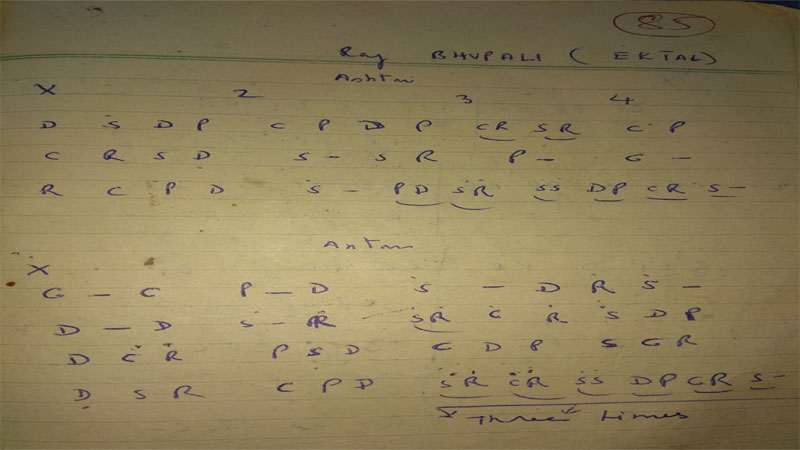
**Composition taken from notebook of his handwriting. ** GA-C
Raag- Hameer
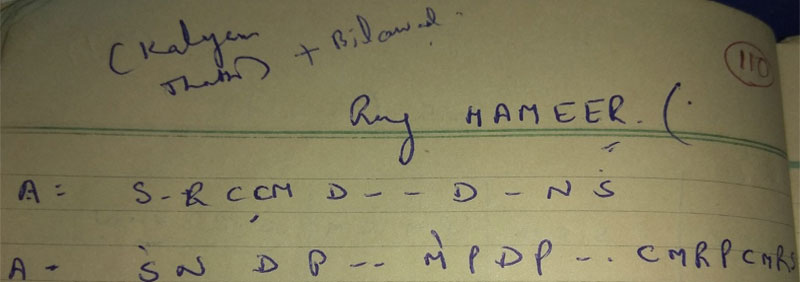
Rupak Taal MadhyaLaya Composition:-
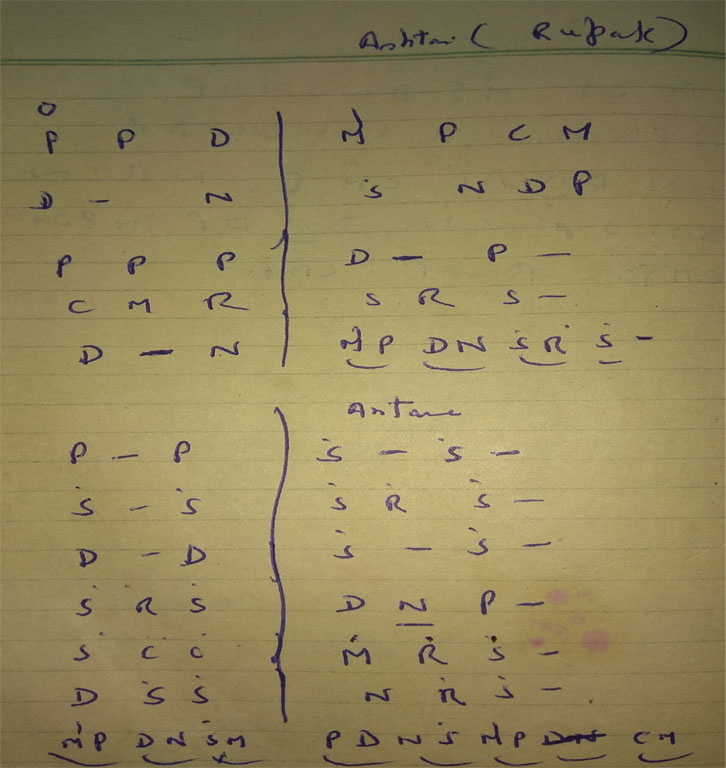
**Composition noted from notebook of his handwritting. **GA-C
References:-
1. Saha Pt Samar, About Pt.V.G.Jog- interview, 2016
2 Datta,Debabrata.Sangit Tatta Part-2.Kolkata.Brati Prakashani,2007,Page 121-122
3. Edi.by Ghosh, Lt Pt Nikhil.The Oxford Encylopaedia of the Music Of India h-o,Sangit Mahabharati?:Oxford University Press,?,Page-484
4 a,b. ?,?. “Few time spent with Pt.V.G.Jog”-a interview by Leo Madhumita Bothra. Celebrates 70th Birth Day of Padmabhushan Pandit V.G.Jog,1991
5.?,?. Padmabhushan Pandit V.G.Jog Celebrates. 75th Birth Day of Pandit V.G.Jog Violin Virtuosa of India.1996
- Edi.by Ghosh, Lt Pt Nikhil.The Oxford Encylopaedia of the Music Of India p-z,Sangit Mahabharati?:Oxford University Press,?
- 7. SharmaDas, Amal. Musicians of India past and Present, Gharanas of Hindustani Music and Ganealogies.Calcutta:Naya Prokash,?
- DharChoudhury,Sisirkana. The origin and evaluation of Violin- as a musical instruments: and its contribution to the progressive flow of Indian Classical music. Kolkata:Ramakrishna Vedanta Math, 2010
- Interview with Pt.Ajoy Chakraborty(Vocalsit),Subhankar Banarjee(Tabla),Ravi Srinivasan(Director of Sangeet Research Academy(SRA),Kolkata)
Anirban Biswas, Ph.D Scholar, Music Department, Tripura University